Showing posts with label cultivars. Show all posts

Saturday, February 18, 2023

Crapemyrtle Varieties You Should Be Growing

Crape myrtles come in a variety of size sand flower colors. Many (not all) show off an ornamental patchwork bark. Before heading to the garden center decide what flower color you want. Shop the internet or find a variety that grows (matures) to the correct height for the garden space and is winter hardy in your plant zone. Plant crape myrtles almost any time of year with spring / summer being best and fall / winter the worse seasons. 

There are over 125 varieties listed on the internet. Here is 50+ of the best:
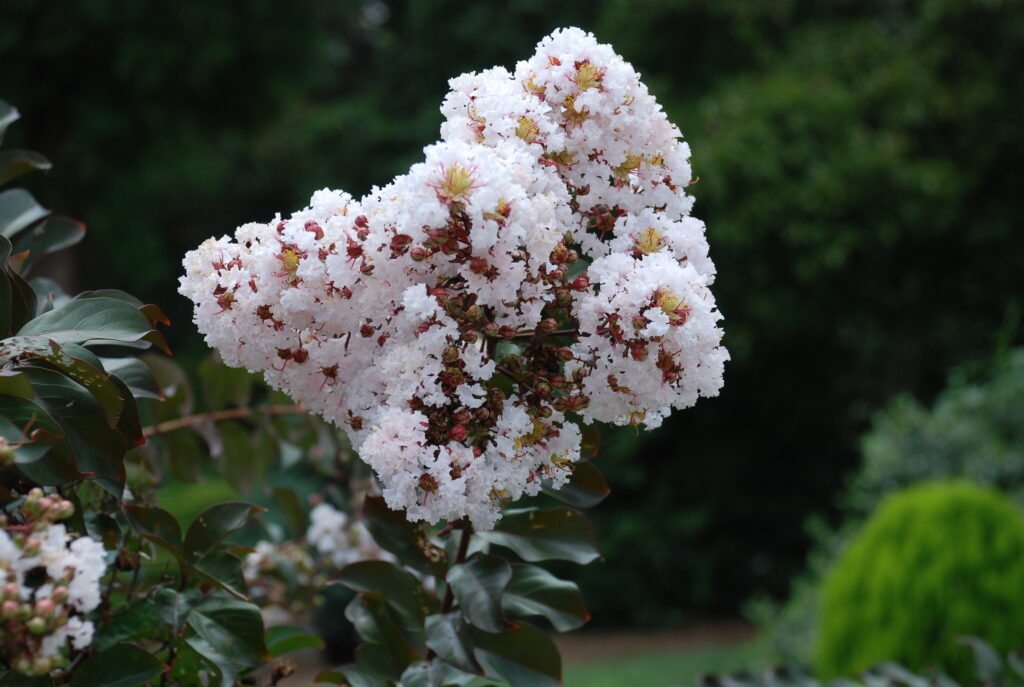
Lagerstroemia 'Burgundy Cotton'

Miniature/Weeping: less than 3
feet tall

  • Baton Rouge (red)
  • Mardi Gras (purple)
  • Pixie White (white)
  • Pokomoke (deep pink)

Dwarf: 3 – 5 feet tall

  • Centennial (purple)
  • Dazzle® series (GAMAD I-VII)
  • Petite Series (6) Pink Ruffles (pink)
  • Tightwad (Whit V) (red)
  • Velma’s Royal Delight (purple)
  • Victor (dark red)

Intermediate: 5 – 10 feet tall

  • Acoma (white)
  • Cheyenne (red)
  • Hopi (pink)
  • Red Rooster (PIILAG III) (rich red)
  • Siren Red (Whit VII) (red)
  • Tonto (red)
  • Zuni (purple)

Medium: 10 – 20 feet tall

  • Apalachee (lavender)
  • Black Diamond series (9)
  • Burgundy Cotton (Whit VI) (white)
  • Catawba (purple)
  • Centennial Spirit (red)
  • Comanche (pink)
  • Dynamite (Whit II) (true red)
  • Lipan (lavender)
  • Osage (pink)
  • Pink Velour (Whit III) (pink)
  • Powhatan (purple)
  • Raspberry Sundae (Whit I) (red/white)
  • Regal Red (red)
  • Seminole (pink)
  • Sioux (pink)
  • Tuskegee (pink)
  • Yuma (lavender)

Tall: more than 20 feet tall

  • Arapaho (red)
  • Biloxi (pink)
  • Byers Hardy Lavender (lavender)
  • Byers Standard Red (red)
  • Kiowa (white)
  • Miami (pink)
  • Muskogee (lavender)
  • Natchez (white)
  • Potomac (pink)
  • Red Rocket (Whit IV) (true red)
  • Sarah’s Favorite (white)
  • Townhouse (white)
  • Tuscarora (pink)
  • Watermelon Red (red)
  • Wichita (lavender)

Thursday, March 15, 2018

Diseased Resistant Flowering Dogwoods


'Appalachian Joy' at NC Arboretum, Asheville, NC
Flowering dogwood (Cornus florida) is a small spring flowering tree that typically grows 15-30 feet tall. It is generally  low-branching, and with a flat-topped canopy.

This beautiful native tree grows best in a moist well-drained soils in 3/4 day sun to light shade. Maintain a 2-4 inch mulch layer around the tree to keep roots cool and moist. It rarely requires pruning, except to remove a broken or dead limb.

Concerns about planting flowering dogwoods (Cornus florida) have calmed over the years  with the introduction of five disease resistant dogwood varieties from the University of Tennessee. Spring availability should be good and come in larger landscape sizes in containers and balled and burlapped (b&b).

Anthracnose resistant cultivar: 'Appalachian Spring'
Powdery mildew resistant cultivars: 'Appalachian Snow', 'Appalachian Blush' and 'Appalachian Mist'.

Additionally, 'Cherokee Brave', with dark pink flower bracts, has proven to exhibit exceptionally good powdery mildew resistance.

Flowering dogwood performs best in southern New England and mid-Atlantic states, eastern Mid-west states (Illinois to Ohio), and southeastern U.S.

Wednesday, March 17, 2010

Best of Perennial Veronicas for Gardens


photo: Veronica spicata 'Royal Candles' (not evaluated in CBG study)

Chicago Botanic Garden (CBG) has published the results of a 10-year study of speedwells (Veronica and Veronicastrum) in its 33rd issue of Plant Evaluation Notes, “A Comparative Study of Veronica and Veronicastrum".

Seven speedwells received good-excellent ratings for their overall performance, including Veronica ‘Fairytale’, V. ‘Giles Van Hees’, V. austriaca ‘Ionian Skies’, V. longifolia ‘Blue John’, V. spicata ‘Baby Doll’, V. spicata ‘Ulster Blue Dwarf’, and V. wormskjoldii. These top-rated speedwells exhibited strong growing and excellent flower production throughout the evaluation period. The lack of any serious pest or disease problems, along with good winter survivability, contributed to their high ratings. Additionally, 18 taxa received four-star good ratings for similarly strong performances.


Speedwells are generally easy to grow and prefer sunny locations in moist, well-drained soils. Plants grown in less light will not bloom as profusely and may become lax or open in habit. Crown loss or plant death may occur in wet soil conditions in winter.


Many speedwells require a midsummer shearing after the first bloom to promote a healthy new basal foliage and to encourage late summer flowering. Deadheading of spent blooms produces many new bloom spikes later in the summer. By selecting the best cultivar(s), you may avoid potential foliar diseases, including powdery mildew, downy mildew, leaf spots, and foliar rust.


Generally, plant disease pressure is more severe here in the Southern Appalachian Region than in the Midwest. Read the entire 8 page CBG report (Issue 33, 2010) authored by Richard G. Hawke.