Showing posts with label drought tolerant. Show all posts

Saturday, February 18, 2023

Crapemyrtle Varieties You Should Be Growing

Crape myrtles come in a variety of size sand flower colors. Many (not all) show off an ornamental patchwork bark. Before heading to the garden center decide what flower color you want. Shop the internet or find a variety that grows (matures) to the correct height for the garden space and is winter hardy in your plant zone. Plant crape myrtles almost any time of year with spring / summer being best and fall / winter the worse seasons. 

There are over 125 varieties listed on the internet. Here is 50+ of the best:
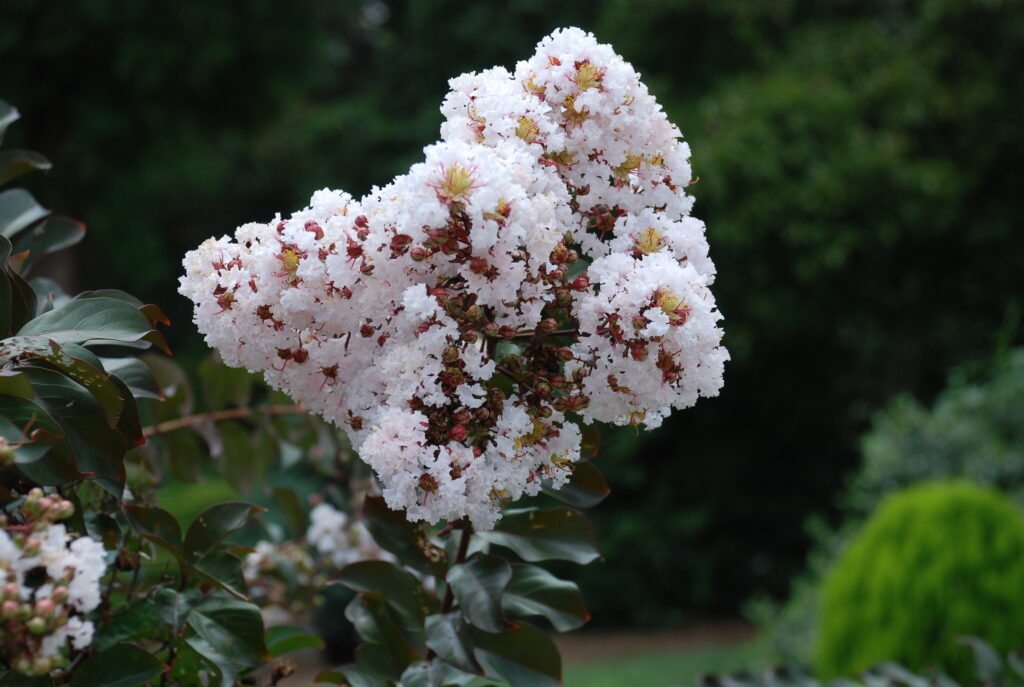
Lagerstroemia 'Burgundy Cotton'

Miniature/Weeping: less than 3
feet tall

  • Baton Rouge (red)
  • Mardi Gras (purple)
  • Pixie White (white)
  • Pokomoke (deep pink)

Dwarf: 3 – 5 feet tall

  • Centennial (purple)
  • Dazzle® series (GAMAD I-VII)
  • Petite Series (6) Pink Ruffles (pink)
  • Tightwad (Whit V) (red)
  • Velma’s Royal Delight (purple)
  • Victor (dark red)

Intermediate: 5 – 10 feet tall

  • Acoma (white)
  • Cheyenne (red)
  • Hopi (pink)
  • Red Rooster (PIILAG III) (rich red)
  • Siren Red (Whit VII) (red)
  • Tonto (red)
  • Zuni (purple)

Medium: 10 – 20 feet tall

  • Apalachee (lavender)
  • Black Diamond series (9)
  • Burgundy Cotton (Whit VI) (white)
  • Catawba (purple)
  • Centennial Spirit (red)
  • Comanche (pink)
  • Dynamite (Whit II) (true red)
  • Lipan (lavender)
  • Osage (pink)
  • Pink Velour (Whit III) (pink)
  • Powhatan (purple)
  • Raspberry Sundae (Whit I) (red/white)
  • Regal Red (red)
  • Seminole (pink)
  • Sioux (pink)
  • Tuskegee (pink)
  • Yuma (lavender)

Tall: more than 20 feet tall

  • Arapaho (red)
  • Biloxi (pink)
  • Byers Hardy Lavender (lavender)
  • Byers Standard Red (red)
  • Kiowa (white)
  • Miami (pink)
  • Muskogee (lavender)
  • Natchez (white)
  • Potomac (pink)
  • Red Rocket (Whit IV) (true red)
  • Sarah’s Favorite (white)
  • Townhouse (white)
  • Tuscarora (pink)
  • Watermelon Red (red)
  • Wichita (lavender)

Tuesday, October 16, 2018

Inkberry Holly A Worthy Substitute For Boxwood


Ilex glabra 'Densa'
Inkberry holly (Ilex glabra), also called gallberry, is a slow-growing broadleaf evergreen shrub (USDA hardiness zones 4-9). Inkberry grows to 5-8 feet tall and, if not pruned, may spread by root suckers to form colonies. 

Inkberry is native  from eastern Canada to Florida, west to Louisiana.  The dark green glossy leaves (to 1.5” long) have smooth margins and are spineless. Foliage stays attractive in winter unless temperatures dip below 0 °F. Greenish white flowers appear in spring, but are mostly inconspicuous.

Inkberry grows in average, medium to wet, acidic soils and in full sun to partial shade. It is one of few holly species that tolerates wet soils. Inkberries are dioecious (separate male and female plants). Female plants need a male pollinator to produce black,  3/8 inch diameter, berry-like (drupe) fruits that mature in early fall and persist throughout late winter into early spring unless consumed by birds and other wildlife.

Inkberry holly is a popular hedging shrub that tends to grow faster than a boxwood. Prune in early spring before new growth begins. Plants generally need minimal pruning unless used as a hedge. Remove root suckers as they form. Many landscape cultivars do not root sucker as badly as species. 
Leading cultivars are 'Densa', 'Shamrock', and 'Nordic'
No serious insect or disease problems trouble inkberry hollies. Leaf spotting occurs in wet summers. Spider mites may appear, especially during dry spells. In high pH (alkaline) soils, foliar chlorosis (yellowing) may happen.
Mass or group several inkberry hollies as a shrub border, a low foundation planting. Species inkberries will naturalize in moist woodland gardens or near streams or ponds.

Honey derived from inkberry flowers is a highly-rated. It is locally marketed in certain parts of the southeastern U.S. Dried and roasted inkberry leaves were first used by Native Americans to brew "Appalachian tea" a black tea-like drink.

Sunday, July 25, 2010

Pennisetum 'Karley Rose'

Asian fountain grass cultivar 'Karley Rose'(Pennisetum orientale) is a four season eye-catcher. It is reliably hardy in USDA zones 5-9. It produces smoky rose colored flower spikes (plumes) in early summer, which persist thru the winter months. Its dark green foliage begins upright in form, 2 1/2 feet tall, achieving 3 feet in height in flower. By mid- summer the grass blades cascade down, true to the name “fountain grass”.

Grow ‘Karley Rose’ in full sun or partial areas with 6 hours sunlight to maintain optimum grass form and plume color. Despite proven drought tolerance, it prefers to grow in compost rich, well-drained soil. It has a wide soil pH preference from acidic to slightly alkaline (6.2 to 7.5).

This clump growing grass is quick to establish and prospers for many years. Annual maintenance is minimal. In late fall or late winter cut back the old foliage to 3-4 inches and feed with a high nitrogen lawn grade fertilizer. Fountain grass has no serious disease or insect problems and is deer resistant and salt tolerant.

The handsome foliage and attractive flower spikes of ‘Karley Rose’ provide excellent texture and seasonal color. Use as an accent specimen or group together in mass plantings.

Monday, May 3, 2010

Hybrid Decidous Azaleas Brighten The May Garden


The bright reds, oranges and yellows of the hybrid deciduous azaleas (Rhododendron spp.) are lovely among tall shade trees which protect them from the harsh afternoon sunlight of summer. Because their bloodline is from our native piedmont azalea species in the Eastern U.S., hybrid deciduous cultivars possess exceptional disease and insect resistance rarely seen in the more popular evergreen forms.
This past weekend I saw this lemon yellow gem (pictured) in a friend's garden in Lenoir, NC called 'Sunny Side Up'. The very popular 'Gibraltar' (bright orange) has been blooming over the past 15 years blooming in my northeast TN garden next to 'Gold Finch' (yellow-gold).
Annual care is very minimal: Feed once after flowering with any slow release azalea or evergreen fertilizer. To invigorate the azalea, prune back one or two very tall woody branches near the base of the shrub to promote new shoot growth. The new branches will likely flower next spring and many more thereafter. One year established shrubs are also very drought tolerant.

Monday, January 4, 2010

Big Begonias


The Benary 'Big Begonia' series are a hit, "begonias on steroids", some gardeners may say. Individual flowers are twice that of other bedding begonias. Colors are vivid with three cultivars currently available . 'Big Rose Bronze Leaf' is my personal favorite. (pictured)
Begonias grow best in well drained, humus-rich garden soil. Provide tender -loving care for the first 4 weeks in the spring, and plants will bloom non-stop through a long hot, dry summers into the first hard frost autumn.

Plant the Big begonias in full sun or partial sun (a minimum of 5 hours of sun recommended). Disease and insect pests are rarely an issue for these tough, non-stop flowering annuals. Do not plant begonias in the same garden spot more than 3 consecutive years to avoid buildup of soil pathogens.

Angelonia in the Summer Garden

Tired of marigolds and petunias? Angelonias (A. angustifolia) are superior summer garden annuals. Angelonias require very little care. They possess superior heat and drought tolerance.
I prefer the Serena series (seed produced type) because local greenhouse growers produce and sell them more cheaply. Vegetative (cutting) type angelonias grow taller, are heavy bloomers, and are more pricey at garden centers.

Varieties of 'Serena' angelonia come in white, pink lavender, lavender, and purple flowers. Plant them after the danger of spring frosts in your gardening area is low. After planting, follow-up with a few early waterings. Then, sit back and enjoy angelonas in constant bloom from late spring to the first hard frost of autumn.

Serena angelonias grow 12-15 inches in height and 14-16 inches in spread in my zone 6-b garden.

photo: pentas (front) and 'Lavender Pink Serena' angelonia (rear)